
God could have made crows and sparrows, then called it a day. But no, doing more than we could ask or imagine just happens to be his way. He placed so many different birds in this world!
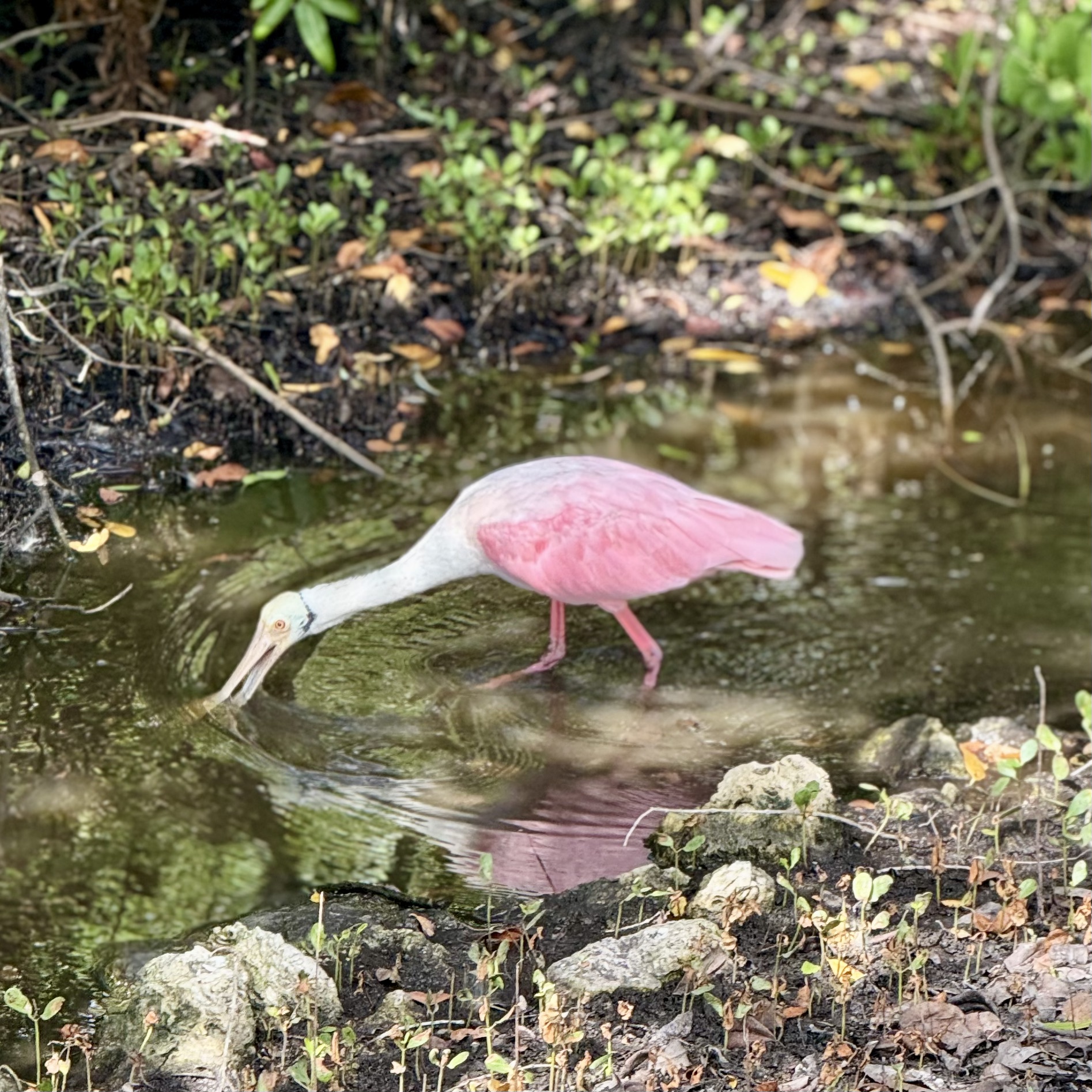
Occasionally, in the marshy mangroves along Florida’s Gulf Coast, I receive the rare delight of spotting one of my favorite birds, the Roseate Spoonbill. Every time I do it’s a wonderful surprise! I love watching them gracefully maneuver through the muddy water and use their spoon-like bill to forage for food. I’ve read that they look like a whimsical creature straight out of a Dr. Seuss storybook, and it’s true. They somehow embody both charm and silliness. I can’t get enough of them.
God must of had a good time creating the Roseate Spoonbill, don’t you think? Imagine adorning it with those flashy pink feathers and long spindly legs. Then, deciding on a balding green head and intense red eyes. And, why not flatten the beak too, make it look like a spoon? Ta da! Extraordinary! Who could pass by such a unique bird and not take notice? And, maybe that’s the point. Perhaps God created the Roseate Spoonbill to encourage us to notice…to notice not only what has been created, but also the One who created it. In the Bible, we can find wisdom aligning with that thought. Here’s one such verse:
For ever since the world was created, people have seen the earth and sky. Through everything God made, they can clearly see his invisible qualities—his eternal power and divine nature. So they have no excuse for not knowing God.
Romans 1:20
Creation Displays the Character of its Creator
Roseate Spoonbills, like other things appreciated in nature, provide an up-close and personal opportunity to learn more about God. Similar to the way a piece of artwork displays the character of its artist, creation displays the character of its Creator. Nature acts as a visible reflection of the invisible Creator, a mirror of sorts, showing us what he is like.
What might God be revealing about himself through the Roseate Spoonbill?
God’s character is intentional. He designs on purpose for good purposes.
A Peculiar Bill and Stealth-like Movements
The Roseate Spoonbill’s peculiar bill is certainly an attention grabber, but it also functions as a very useful tool. It is outfitted with extremely sensitive touch receptors which aid in detecting prey such as small crustaceans, fish, insects, mollusks, and other aquatic invertebrates.
Roseate Spoonbills step slowly, quietly, and deliberately through shallow marshy areas as they forage for food. To the observer, they seem unhurried and completely absorbed in their work. While seeking prey underwater, their bills remain partially open as their heads sweep side to side in wide arcs (like a scythe) through the muddy waters. This tactile foraging method, also known as “head-swinging,” assists in sensing and filtering out prey, allowing the bird to snatch it up with amazingly quick reflexes.
A Spiritual Application
God gave the Roseate Spoonbill a unique bill and foraging method to help it flourish in marshy environments. Certainly, his design of the bird’s bill and stealth-like movements have a practical purpose, but they can also have a spiritual purpose in our lives. For example, the Roseate Spoonbill’s calm, deliberate movements while foraging could serve as God’s reminder to slow down the pace of life or to patiently trust in his perfect timing of events. The bird’s distinct bill might be God’s way of teaching us about the creativity and originality he puts into everything he creates–including us.
At times, our uniqueness can feel difficult, but God crafts loving purpose into all his creations. He doesn’t make mistakes. Like Roseate Spoonbills, we too are purposefully made in spectacular ways which help us flourish and display God’s goodness more clearly to others.
(Ephesians 2:10, Psalm 139:13-14, Jeremiah 1:5, Jeremiah 29:11)
God’s character is patient and persevering.
Maturing and Perfecting His Creation
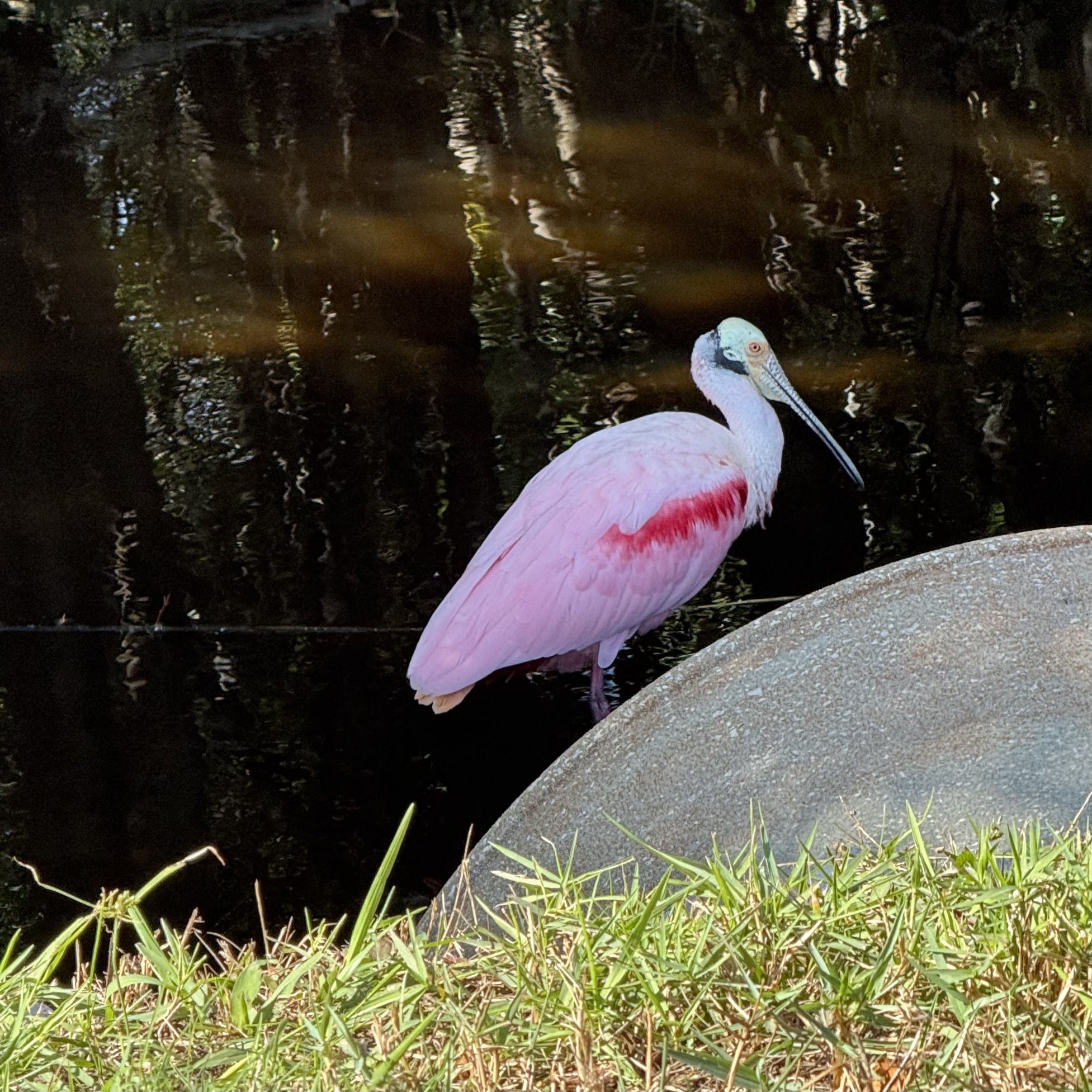
Interestingly, Roseate Spoonbills are not born with their famous spoon-shaped bills or vibrant pink feathers. Their bills begin flattening when they are about nine days old, and continue to do so until they reach full-size, at approximately thirty-nine days old.
And, newly hatched chicks (lovingly called “teaspoons”) do not arrive fully feathered. Instead, they appear barely covered with fluffy tufts of white down. As juveniles, their feathers are white with slight hints of peachy-pink. Gradually, as they mature over the course of a few years, the bright rosy-pink (roseate) plumage symbolic of their name appears. Linked to a carotenoid-rich diet of organisms containing natural red and orange pigments (e.g. shrimp, crayfish, crabs), the intensity of their coloring varies from pale pink to deep magenta, depending on their specific age, diet, and breeding season.
A Spiritual Application
God takes his time in perfecting the design of the Roseate Spoonbill. Chicks don’t hatch equipped with a bill that serves as an awesome food prep tool for skimming and filtering. They don’t arrive with wings that are impressively pink and ready-to-fly. In a similar way, God takes his time shaping our spirits into his intended design. His transformation is a lifelong renewal of heart and mind for the believer, a gradual process by which the Holy Spirit guides growth in holiness, changing one’s character to become more and more Christlike.
As long as we live in this fallen world, God’s handiwork in and through us is not finished. Ever patient and persevering with his art, he continues shaping and refining us into masterpieces which reflect the character of Christ.
(2 Corinthians 5:17, Romans 12:2, Ezekiel 36:26, Philippians 1:6, Ephesians 4:22-24, 2 Corinthians 3:18)

God’s character is loving, faithful, and sustaining. He takes care of his creation.
Provision in the Struggles of Life
The fresh and saltwater wetlands along the southeastern coast of the United States, Mexico, as well as Central and South America, offer an ideal habitat for Roseate Spoonbills. Here, they can build comfortable nests in shady trees and shrubs near the shallow waters where they roost and forage. Roseate Spoonbills are social birds who like gathering in groups, so they commonly share these sites of activity with other wading birds such as ibises, herons, egrets, and storks. Together, they form large and busy mixed-species colonies.
But, life hasn’t always been a “big party” for the Roseate Spoonbills. Miraculously, they have survived in spite of some serious trouble over the years. In the 1800s, plume hunters slaughtered them for their beautiful feathers, nearly wiping out the population. More recently, they have faced additional threats from modern society including: changing water quality and prey availability from pollution effects, loss of habitat, and changes to or removal of their shallow foraging spaces due to rising sea levels. Despite these difficulties, Roseate Spoonbills have continued surviving and even thriving. Scientists report the birds are often adapting to their current environmental challenges by moving nesting areas further inland or to entirely different areas.
A Spiritual Application
If God has continued making a way for the Roseate Spoonbills to thrive, regardless of their trouble, imagine how much more he will do for us, whom he created in his own image. God is aware of every situation we find ourselves in and he will never leave us to fend for ourselves. We are completely known, loved, and never forgotten. God cares deeply about all of his creation, but especially his people.
As faith deepens, we recognize more and more that God is in control of all life’s events and timing. We can trust him to provide what we need and to ultimately fulfill his good plans for our eternal future with him.
(Matthew 6:26, Matthew 10:29-31, Philippians 1:6, Romans 8:28)

God’s character is joyful.
Special Attention to Detail
Just one glance at the Roseate Spoonbill tells you it was created with joy. From the top of its balding greenish-gold head to the bottom of its scaly prong-like pink toes, this bird is far from ordinary. Those gorgeous pink feathers, intriguing flat bill, striking red eyes, long skinny legs…Surely, God delighted in making that. (Maybe it even “tickled him pink,” as my grandma would say.)
In addition to its gorgeously quirky appearance, God also gave Roseate Spoonbills some interesting behaviors. As already mentioned, they swing their heads side to side through the water while they search for food. And, unlike other wading birds who dip their bills vertically into the water while foraging, the Roseate Spoonbill maintains an upright posture and lowers its bill horizontally into the water.
Also, some other larger birds tuck their legs underneath themselves in flight, but Roseate Spoonbills let theirs trail behind them. Seemingly relaxed and confident, they fly with their legs dangling and necks stretched out straight, harmonizing quick, shallow wingbeats with slow, deeper glides. And, if they happen to fly over other Roseate Spoonbills, those below will pause what they are doing to look, pointing their necks and bills straight up in a pose called “sky gazing.” So awesome, I’d really like to see that!
A Spiritual Application
Through the Roseate Spoonbills and all of nature, we see evidence that God loves creating AND he loves what he creates. Highlighting intriguing details and beautiful variety, each design puts his joy on display.
All the behaviors of the Roseate Spoonbill are intriguing, but I think it’s especially fascinating that they demonstrate a sense of awe and wonder at each other in flight. Sure, it could simply be an instinctual behavior, but still, doesn’t it provide a wonderful example for us? If they can be so captivated by God’s creation, then how could we not be?
It’s hard to ignore the presence of God’s joy in creation. His joy is all around us, inspiring awe and wonder, beckoning us to look closer and longer, generously sharing the essence of who he is. God is so good.
(Psalm 104:31, Colossians 1:16, Zephaniah 3:17, Psalm 19:1, Job 12:7-8)
A Prayer–
God, thank you for providing glimpses of your character through nature. You show me everything was created on purpose and for a purpose, including me. Even when my spiritual growth stalls or feels slow, help me trust in the care, progress, and protection you promise to provide. Help me recognize and learn from the ways you are sharing your character with me. Teach me how to make good use of the uniqueness you gave me. Position me to humbly share your joy in our hurting world. In Jesus Name, Amen
Press on in faith my friends! ~Jamie
Related Posts:
- Learning about God through Nature
- When you don’t feel like God’s masterpiece, remember this…
- Getting to Know God Better
- A Candid Photo of Jesus
- Loving God with All your Heart, Soul, Mind, and Strength
- Three Ways Play Helps us Pray
Inspiring Resources:
- All About Birds, Roseate Spoonbill Overview –allaboutbirds.org
- The Flight of the Spoonbills Holds Lessons for a Changing Everglades–and World –audubon.org
- Wikipedia, Roseate Spoonbill –wikipedia.org
- Florida Fish and Wildlife Commission, Roseate Spoonbill –myfwc.com
- Bird Gallery: Roseate Spoonbill, Houston Audubon –houstonaudubon.org
- Birds of the Bible–Roseate Spoonbill –Lee’s Birdwatching Adventures Plus, leesbird.com
- Roseate Spoonbill: 5 Fascinating Facts –Badgerland Birding on YouTube
Stay in Touch
I’d love to have you join my group of email subscribers. Join now and receive my list of 20 Scriptures to Tuck Away for Difficult Days.
